

PFAS in Food Packaging and Straws
PFAS & Health: Why These Chemicals Matter More Than You Think
PFAS have become part of our everyday environment. They’re in drinking water, food packaging, textiles, dust, and increasingly in the bodies of people around the world.
So the real question is:
If PFAS are everywhere, what does that mean for our health?
Here’s a clear look at what scientists know today and why growing regulation is putting human health at the center of the PFAS debate.
PFAS stay in the body for years
PFAS are built on one of the strongest bonds in chemistry: the carbon-fluorine bond. Once inside the body, many PFAS bind to proteins in the blood and liver. Some long-chain PFAS (like PFOA and PFOS) remain for:
2–7 years per half-life (ATSDR)
This slow elimination means even small, repeated exposures can add up over time.
What research says about PFAS and health
Not all PFAS behave the same, and not all health effects are proven for every substance.
But large epidemiological studies and regulatory reviews show consistent associations (especially with long-chain PFAS).
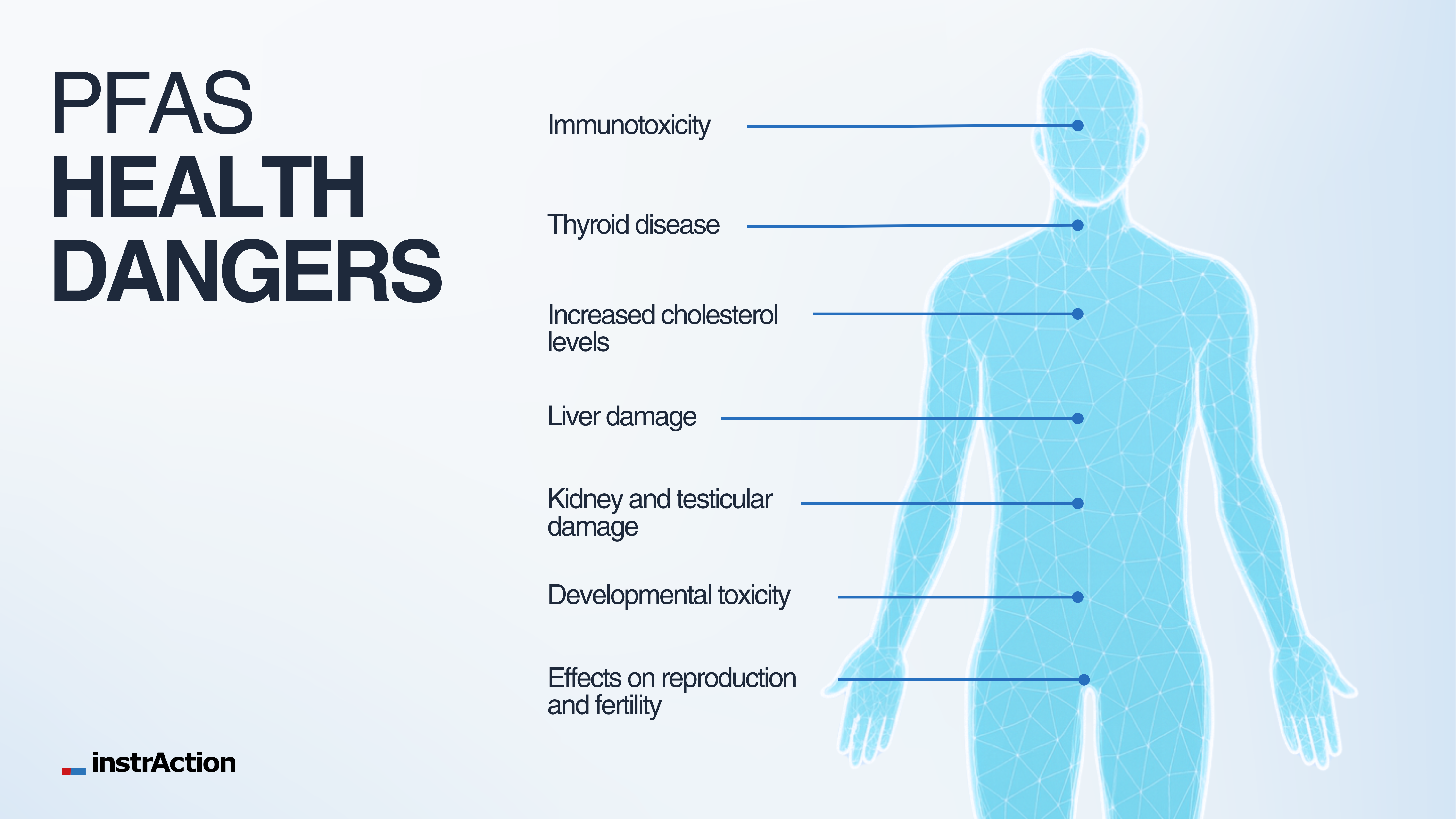
Here’s the science-based picture:
Immune System (well documented)
- Reduced vaccine response in children
- Increased susceptibility to infections
Sources: EFSA, ATSDR, National Academies
This is one of the most well-established PFAS health effects.
Cancer (associated)
Long-term PFOA exposure has been associated with:
- Kidney cancer
- Testicular cancer
These links come mainly from high-quality cohort studies (e.g., the C8 Studies).
Reproductive & Developmental Effects (associated / suspected)
Studies observe associations with:
- Reduced fertility
- Pregnancy-related hypertension
- Lower birth weights
- Developmental delays
While not causal for all PFAS, the patterns are consistent enough that regulators treat them as risks.
Hormonal & Metabolic Effects (suspected)
Evidence suggests PFAS may influence:
- Thyroid function
- Cholesterol levels
- Liver enzymes
These effects vary by PFAS type, but they point toward broad endocrine interaction.
Why children are especially vulnerable
Children are more exposed per kilogram of body weight, and their immune systems and organs are still developing.
Additional reasons:
- PFAS cross the placenta
- PFAS are present in breast milk
- Infants and small children inhale more dust per kg
- Their immune response is more sensitive to change
This is why many countries push PFAS drinking water limits to extremely low levels.
Where your PFAS exposure actually comes from
Drinking water is a major pathway in contaminated regions, but it’s not the only one. PFAS exposure varies by region, but the largest contributors typically include:
- Drinking water
- Food packaging (especially greasy food)
- Seafood
- House dust
- Treated textiles (carpets, sofas, outdoor gear)
What can you do today to protect your health?
PFAS exposure can’t be eliminated fully, but it can be reduced.
- Check PFAS levels in your region
Use local utility reports or national databases (where available). Many regions now publish PFAS data monthly. In Germany, for example, a tap-water map was recently released for several major cities.
If levels are elevated, consider temporary precautions for infants, children, and other vulnerable groups, for example using certified point-of-use filters or, where appropriate, alternative water sources.
- Reduce contact with PFAS-heavy products
Especially:
- Non-stick cookware with unknown coatings
- Water-repellent sprays
- Grease-resistant fast-food packaging
- Consider certified filters
Point-of-use filters (GAC + ion exchange + advanced absorbers) can significantly reduce PFAS in tap water.
- Stay informed
PFAS regulations are evolving rapidly. Check out our EU regulation blog to see what will change from 2026 to 2040.
We think awareness is genuinely one of the strongest tools right now.
Final Thoughts
PFAS are not a theoretical risk. They are chemicals we encounter in our daily environment.
The scientific evidence continues to grow, and regulators are responding with increasingly strict water limits and monitoring rules.
For communities, industries, and policymakers, understanding the health dimension is essential to making the right decisions.
Cleaner water isn’t just an environmental target, it’s a health investment for the next generation.
If you want to know more about PFAS and the work we do, check out our brochure to get the information in a nutshell.
Sources:
- European Environment Agency
- Umweltbundesamt
- United States Environmental Protection Agency
- Mišľanová C, Valachovičová M. Health Impacts of Per- and Polyfluoroalkyl Substances (PFASs): A Comprehensive Review. Life (Basel). 2025 Apr 1;15(4):573. doi: 10.3390/life15040573. PMID: 40283131; PMCID: PMC12028640.
- Fenton SE, Ducatman A, Boobis A, DeWitt JC, Lau C, Ng C, Smith JS, Roberts SM. Per- and Polyfluoroalkyl Substance Toxicity and Human Health Review: Current State of Knowledge and Strategies for Informing Future Research. Environ Toxicol Chem. 2021 Mar;40(3):606-630. doi: 10.1002/etc.4890. Epub 2020 Dec 7. PMID: 33017053; PMCID: PMC7906952.